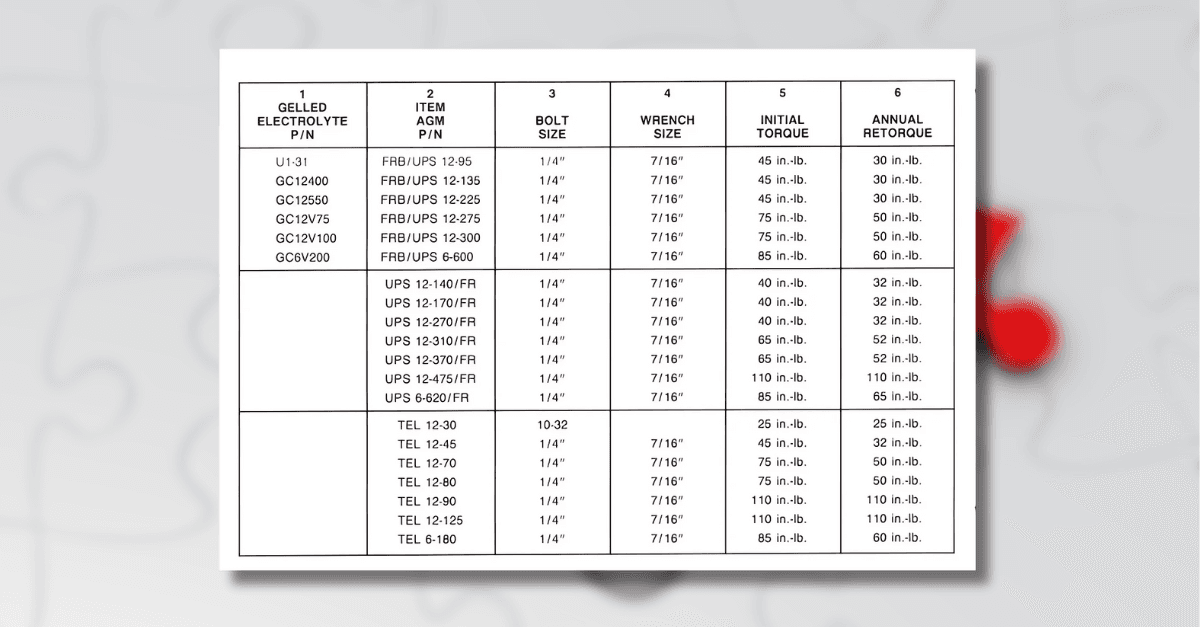
Assemble the battery at its installation site with the final inter-cell links, cables, and torque per manufacturer spec.
Record open-circuit voltage (OCV) for every unit before any charging.
Ensure interconnects and cable gauges match the intended operating configuration.
Equalize charge
Duration: 24 hours
Setpoint: 2.40 V/cell (≈ 14.4 V/unit for 12 V blocks with 6 cells)
Float charge
Duration: 3–7 days
Setpoint: 2.25 - 2.30 V/cell (13.50 - 13.80 V/unit for 12 V blocks)
Log voltages
Measure and record each unit’s voltage during both equalize and float. Look for outliers.
Tip: Stabilized, fully floated batteries yield more reliable capacity numbers and reduce scatter test-to-test.
Constant Current (A): Hold current constant; commonly used for telecom DC plants.
Constant Power (W/cell or W/unit): Hold power constant; typical for UPS where bus voltage varies during discharge.
Use the manufacturer’s recommended EOD per cell. Common values for VRLA are 1.75–1.80 V/cell. For 12 V blocks (6 cells), multiply by 6 (e.g., 1.75 V/cell → 10.5 V per 12 V unit).
Choose the rated time from the datasheet (e.g., 1 h, 3 h, 10 h, 20 h). Your target load comes from the table for that duration and EOD.
Load bank sized for the required current or power at the system voltage
DC ammeter (for current) and digital voltmeter (for each unit and string total)
Timer (or data logger)
Battery cell monitoring system (optional but recommended)
Torque tools per hardware spec
Connect the load bank across the full string (e.g., 48 VDC systems with hundreds of amps may require 10 kW+ loads).
Verify polarity, shunt orientation (if used), and that metering reads correctly at a small pilot load before the real run.
Many standards accept strings ≥ 80% of rated capacity as “serviceable,” but follow your organization’s threshold.
If the string fails:
Identify weak units (lowest per-unit voltages under load, abnormal IR/conductance if measured).
Replace weak units and retest after the full charge protocol.
Battery model, count, configuration, installation date
Charge history before test (equalize/float durations and setpoints)
Temperature and correction factor used
Test mode (constant A or constant W), EOD, rated duration
Measured time to EOD and calculated Rated Capacity (%)
Per-unit voltage logs (at intervals)
Observations, anomalies, corrective actions
Do not skip float stabilization (3–7 days). Under-charged strings under-perform.
Hold the setpoint steady. For constant-current tests, keep current within ±1–2%.
Measure individual units. Weak blocks often hide behind “OK” string voltage.
Apply the correct EOD. A higher/lower EOD can inflate/deflate measured capacity.
Use the right correction table. Use the manufacturer’s factors for your exact model.
Document everything. Good logs make trend analysis and warranty claims easier.
A good capacity test is mostly good preparation: proper charge, correct temperature correction, the right EOD, and disciplined logging. With those in place, the math is simple—and the result is a trustworthy Rated Capacity (%) you can compare across years to plan maintenance and replacements.
ทีมวิศวกรของเราพร้อมช่วยคุณเลือกโซลูชันที่เหมาะสม
