BEMoS — Battery Enterprise Monitoring System (S-Series)

Block-level battery monitoring with per-block voltage and resistance sensing, in 2V or 12V models. Scales to 512 blocks across 16 strings. Integrates with SCADA, SNMP, MQTT, and IEC 61850.
3 min read 2 views
BEMoS — Battery Enterprise Monitoring System (S-Series)

What BEMoS S-Series does

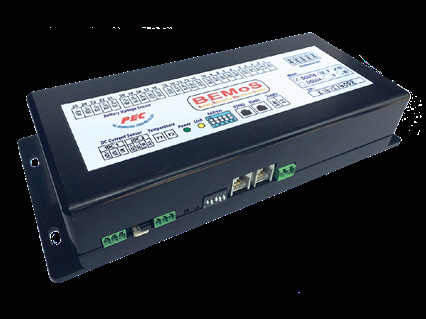
BEMoS S-Series is PEC's block-level Battery Monitoring System — built for large stationary banks where you need visibility down to the individual cell or block, not just the module. The Local Control Unit (LCU) and Data Gathering Units (DGU RI) measure every block's voltage and internal resistance continuously, across 2V or 12V cell configurations, so a weak block on any string surfaces on the dashboard weeks before it fails a capacity test — or takes the string down during a real outage.

Main features

  • Fully embedded TCP/IP and Web server — view any site from any browser, no client install.
  • Measures parameters across up to 512 blocks and 16 strings from a single system.
  • RS485 sensor bus for battery voltage, resistance, current, and temperature; optional ripple voltage / current measurement.
  • Real-time block voltage and string voltage; on-demand internal resistance test (auto or manual; ≈15 days for a full scan at maximum coverage).
  • Built-in 2 dry-contact inputs and 4 relay outputs for plant interlocks.
  • Touchscreen display, LED, and buzzer for on-site annunciation; user login for access control.
  • SD-card data + event logging with timestamp; alarm delivery by email or SMS (optional).

Sensors

  • DGU RI — up to 24 blocks of voltage and resistance per module, expandable up to 16 modules.
  • Two nominal-voltage families: 2V model (1.2 V / 2 V cells) and 12V model (4 V / 6 V / 8 V / 12 V blocks).
  • Voltage range 0–3 V for the 2V model, 0–18 V for the 12V model (accuracy 0.1%, resolution 0.001 V).
  • Resistance range 10 mΩ (2V model) / 37.5 mΩ (12V model) — accuracy ±2%, resolution 0.001 mΩ (2V) / 0.005 mΩ (12V).
  • Temperature 0–80°C (±1°C @ 25°C, resolution 0.1°C).
  • Per-DGU channels: charge/discharge current, float or ground-leakage current, ambient (or pilot) temperature, and a second pilot-temperature channel.
  • External current sensor: closed-loop Hall effect, up to 1000 A, linearity ±0.1%, accuracy ±0.7%.
  • Optional sensors: float current, leakage current, pilot temperature, electrolyte level, hydrogen gas detector.

Local Control Unit (LCU)

  • 10/100 Mb Ethernet RJ-45 (IEEE 802.3-2002 compliant).
  • 48 VDC supply.
  • 4.3" 480×272 colour LCD-TFT with capacitive touchscreen.
  • Status LED (green = power/network, red = fault); buzzer + alarm notification.
  • Protocols: HTTP server, Modbus TCP/IP, SNTP; IEC 61850 and MQTT / HTTP REST available as options.
  • SD-card logging — up to 2 million data records and 2 million event records on the LCU itself.

BMS Server (optional)

  • SQL Express (up to ≈10 GB) — about 5 M data + 5 M event records.
  • SQL Server Enterprise (up to ≈524 PB) — up to ~2 B records each.
  • Recording interval configurable down to 5 seconds.
  • Realtime + historical charts, PDF / Excel report generation, email / SMS notifications, role-based access (Admin, Viewer).
  • Runs on Windows 7/8/10/Server, IIS, .NET 4.0.

Where it pays back

  • Large stationary banks with many strings — block-level resistance trending catches a failing cell long before a whole string trips.
  • Data centres and utility substations standardising on 2V or 12V cell architecture — one monitoring platform covers both.
  • Sites already alerting by SMS — S-Series' native SMS notification means no extra gateway to integrate.

Sources

  1. PEC Technology (Thailand) Co., Ltd., "BEMoS — Battery Enterprise Monitoring System," Version BMS 2.2.4 TSC (S-Series) datasheet.
Contact Us

Interested in this product series?

Request a quote or ask our experts which model fits your application.